Book Review: Prateek Sharma’s Melange & Reflections — Mapping the Inner Universe Through Poetry


Prateek Sharma’s literary journey is, in many ways, a map of a mind growing through solitude, self-interrogation, emotional upheaval, and spiritual softening. With Melange, his debut work, Sharma introduced himself as a poet of introspection, someone who writes not to decorate emotion, but to dismantle it. Years later, Reflections, his third book, reveals the evolution of that same voice: calmer, more distilled, and more willing to embrace vulnerability without dramatizing it.
Together, these two collections, read side by side, trace a compelling arc of artistic and human maturity.
Melange: The First Spark of a Restless Mind

When I first picked up Melange by Prateek Sharma, I expected a poetry collection — perhaps another anthology of free verse and emotional wanderings. What I didn’t expect was to be drawn into a meditative world of lyrical prose that reads like a decade-long dialogue between the self and the universe
A Melange IndeedThe title fits perfectly — Melange literally means “a mixture,” and that’s what the book is at its core: a mixture of moods, tones, and mental landscapes. Each piece carries a distinct emotional signature — sometimes melancholic, sometimes fiery, often hopeful, but always introspective.
The collection is not linear; it’s cyclical — mirroring the tides of our own emotional evolution. One moment, you’re standing at the “edge of the horizon” fighting your inner volcano in Feel the Beat; the next, you’re a wandering soul in Being a Gypsy, seeking meaning amidst chaos. It’s as if Prateek has translated the last ten years of modern human solitude into poetic monologues.
The Language of ThoughtPrateek Sharma’s greatest strength lies in his language. His poetry is dense but not inaccessible — lush with imagery and rhythm, yet grounded in raw feeling. He writes as someone who doesn’t merely describe emotions but dissects them.
Take for instance the lines from Words of Wisdom:“Close your eyes slowlyAgainst the light of the spotless moonNot always accompanied by the stars.”There’s an elegance in his restraint — he doesn’t shout his despair or joy; he lets them breathe between his metaphors. You can almost feel the music in his syntax, the cadence of a mind oscillating between chaos and calm.
Recurring Themes: Hope, Healing, and the Human PsycheEach poem is a meditation on existence. From the existential despair of The Assassin’s End to the quiet awakening in The Heart of the Matter, the poet keeps returning to three major themes:
1. Hope amid darkness – Even in his bleakest imagery, there’s always a shimmer of redemption.
2. The self as both the wound and the cure – He continually explores how we are our own undoing and salvation.3. Love as transcendence – Whether romantic, cosmic, or self-directed, love in Melange becomes a bridge between isolation and identity.
In Worth of You, he writes:“You are a gem that has fallen into nature’s lap...The worth that may not be of worth to the worthless.”Here, Sharma captures what many contemporary poets miss — the paradox of self-worth in a world that constantly devalues introspection.Modernity and Its MalaiseThe later poems like The Unsocial Media and Safe Zone stand apart — more sociological, even critical. They step outside the poet’s internal monologue and confront the outer world — the numbing noise of digital validation, the emptiness beneath modern connection. These pieces feel like reflections of a writer who has seen both eras: the analog quiet and the digital chaos.
Lines like —“A virtual reality threatening our sanity,Blurring the lines between the real and unreal.”— speak directly to our generational fatigue.The Emotional ArcWhat begins as introspection slowly transforms into illumination. By the time we reach Rise and Shine, there’s an unmistakable tone shift — from melancholy to acceptance, from endurance to transcendence. The final pieces — Love is Not Lost, Heaven-Bound, and The Metaphysical Truth — feel almost spiritual, not in a religious sense, but as realizations that emerge after the storm of living.It’s not the voice of someone lamenting life; it’s of someone who has lived it fully, suffered, and returned with lessons.
Stylistic NotesIf there’s one thing readers should know, it’s that Melange is not casual poetry. It demands patience. The verses are long, layered, sometimes abstract — closer to prose-poems than traditional stanzas. Think of it as reading the personal journal of a philosopher who dreams in cinematic imagery.
You won’t “binge” this book; you’ll sip it. Every few pages, you’ll pause — not because you’re lost, but because you’re found.VerdictMelange is a quiet triumph. It’s not loud or revolutionary — and that’s precisely its charm. It doesn’t try to impress; it tries to connect.For those who have known solitude, who have wrestled with self-doubt, love, or purpose — Prateek Sharma’s words will feel like a companion. His verses remind us that every scar is a story, every pause a pulse, and every fall a form of flight.This is not a book to finish; it’s a book to return to.
KeetabiKeeda Verdict: ★★★★☆ (4/5)
Genre: Lyrical Prose / Contemporary Poetry
Best For: Readers who love introspection, emotional depth, and slow-burning optimism.
Comparable To: Rupi Kaur’s emotional honesty, but with the linguistic depth of Khalil Gibran and the cinematic imagination of Paulo Coelho.
Favourite Line:“Because when you are happy,You find and feel yourselfAll the time, all day long, all night long.”
Purchase Link: https://ebooks.bookleafpub.com/product-page/melange-3
Reflections: A Mature, Measured, and More Intimate Third Book
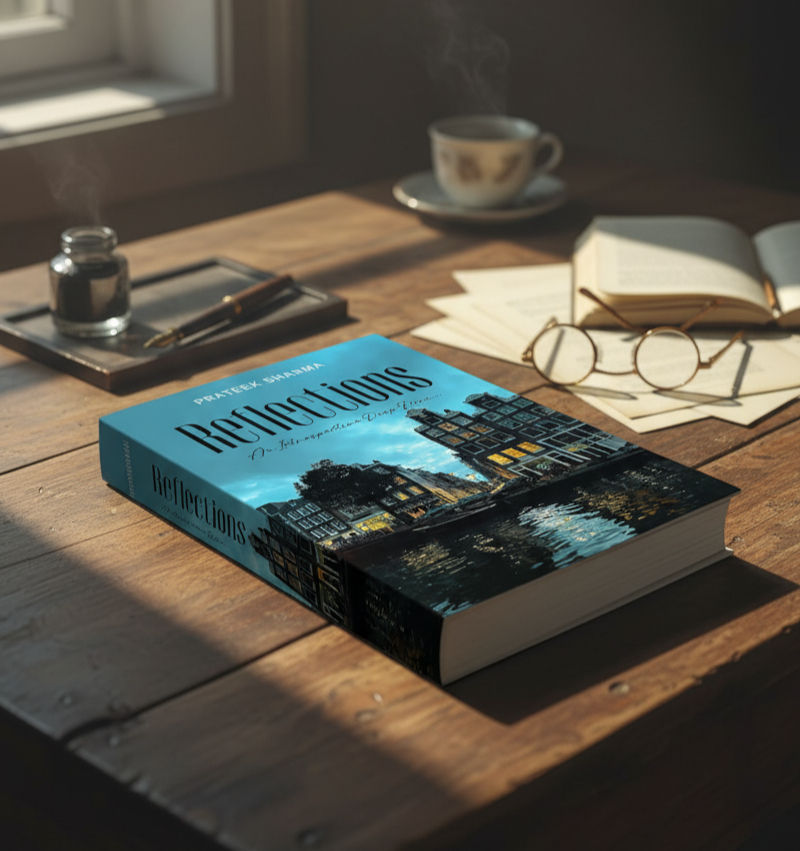
“Reflections” by Prateek Sharma is a deeply introspective poetry collection that invites readers into the quiet recesses of the human mind—its solitude, resilience, desires, and contradictions. Written in free verse, the poems traverse a wide emotional terrain, from melancholy and self-doubt to hope, love, and spiritual awakening. Each poem is a fragment of a life observed keenly, felt deeply, and expressed honestly
At its core, “Reflections” is about the human condition—our ability to endure pain, to heal through self-awareness, and to find meaning amid chaos. Sharma’s voice is both vulnerable and courageous, unafraid to confront themes like existential fatigue (“The Brisk Battle of Revival”), inner duality (“Grey Shades”), and moral disillusionment (“The Evil – In and Around”). These pieces resonate with the struggles of modern existence, where appearances mask turmoil, and resilience becomes both armor and burden.
One of the collection’s strengths lies in its accessibility. Sharma writes not to mystify but to connect. His language is conversational yet lyrical, often evoking vivid imagery: “Just that one shaft of light / Illuminating the path ahead.” It’s this simplicity that allows his work to speak to readers across generations—each finding their own truths reflected in his lines.
“Air of Change” stands out as a poem of transformation, urging readers to embrace renewal and self-rediscovery. “Peace Out, Love Yourself” captures a much-needed message for contemporary readers fatigued by comparison and chaos—the necessity of self-compassion and self-acceptance. Meanwhile, “Gone Are the Good Days” and “Wearing Down” capture the slow erosion of innocence and idealism, echoing a sentiment many urban readers will find painfully familiar.
The emotional arc of “Reflections” is thoughtfully constructed. The early poems are steeped in introspection and struggle, while the later ones hint at resolution and transcendence. “The Omnipresent,” for instance, explores a softened approach toward faith—not rooted in ritual but in a mature spiritual yearning. By the time we reach “Looking Ahead” and “Help Must Be On Its Way,” there’s a sense of cautious optimism, as though the poet has made peace with the flux of life.
Stylistically, Sharma’s work recalls the intimacy of Lang Leav or Atticus but is anchored in an Indian sensibility—less about romanticization and more about contemplation. The recurring motifs of night, light, and inner battles lend cohesion to the collection, making it feel like a continuous emotional journey rather than a disjointed anthology.
However, a few poems occasionally feel verbose, with certain phrases repeating familiar ideas. A tighter edit could have amplified the impact of key emotions. Yet, this rawness is also part of the collection’s charm—it feels unfiltered, as if we are privy to the poet’s spontaneous musings during long nights of reflection.
Ultimately, “Reflections” is a reminder that poetry need not be grand or cryptic to be profound. It thrives on honesty. Prateek Sharma’s work of art is a heartfelt mirror held up to the self—one that reflects not perfection, but persistence.
"It’s a book for those who enjoy sitting by the window on a rainy afternoon, coffee in hand, contemplating life’s unending “journey that goes on and on."
⭐ Verdict: 4/5 “Reflections” is a sincere and relatable collection that captures the essence of human vulnerability and resilience. It’s perfect for readers who seek quiet strength and poetic introspection in their literary journeys.
Purchase Link: https://amzn.to/49pXoGc


Comments